Face · Westlake, Texas
Blepharoplasty
Eyelid surgery, upper or lower. The smallest operation on this list and, for most faces, the one that changes the most.
- Fee$3,400
- In the chairAn hour or less
- Back to work7 to 10 days
01 · What it removes
Three tissues, and the skin is only the first of them.
The practice describes the upper lid operation in one sentence: excess skin, muscle and fat, removed and repositioned. Most people come for the first. The last usually changes the most.
Orbital fat
The fat behind the muscle, pushing forward as the tissue holding it back gives way. It is what a bag under the eye is made of.
Modern technique increasingly repositions this fat into the hollow beneath the eye rather than removing it. Removal is how a lid ends up hollow instead of rested.
The muscle of the lid
A strip of the muscle that circles the eye, addressed where it contributes to the fold, through the same opening as the skin.
The layer nobody asks about, and why two lids with the same skin removed can settle differently.
Excess lid skin
The fold on the crease, on the lashes, or in marked cases in the outer field of vision. The layer everybody names first.
On the lower lid it punishes over-resection hardest: take too much and the lid pulls away from the eye.
02 · Who it suits
The test is what happens when the brow is held where it used to sit.
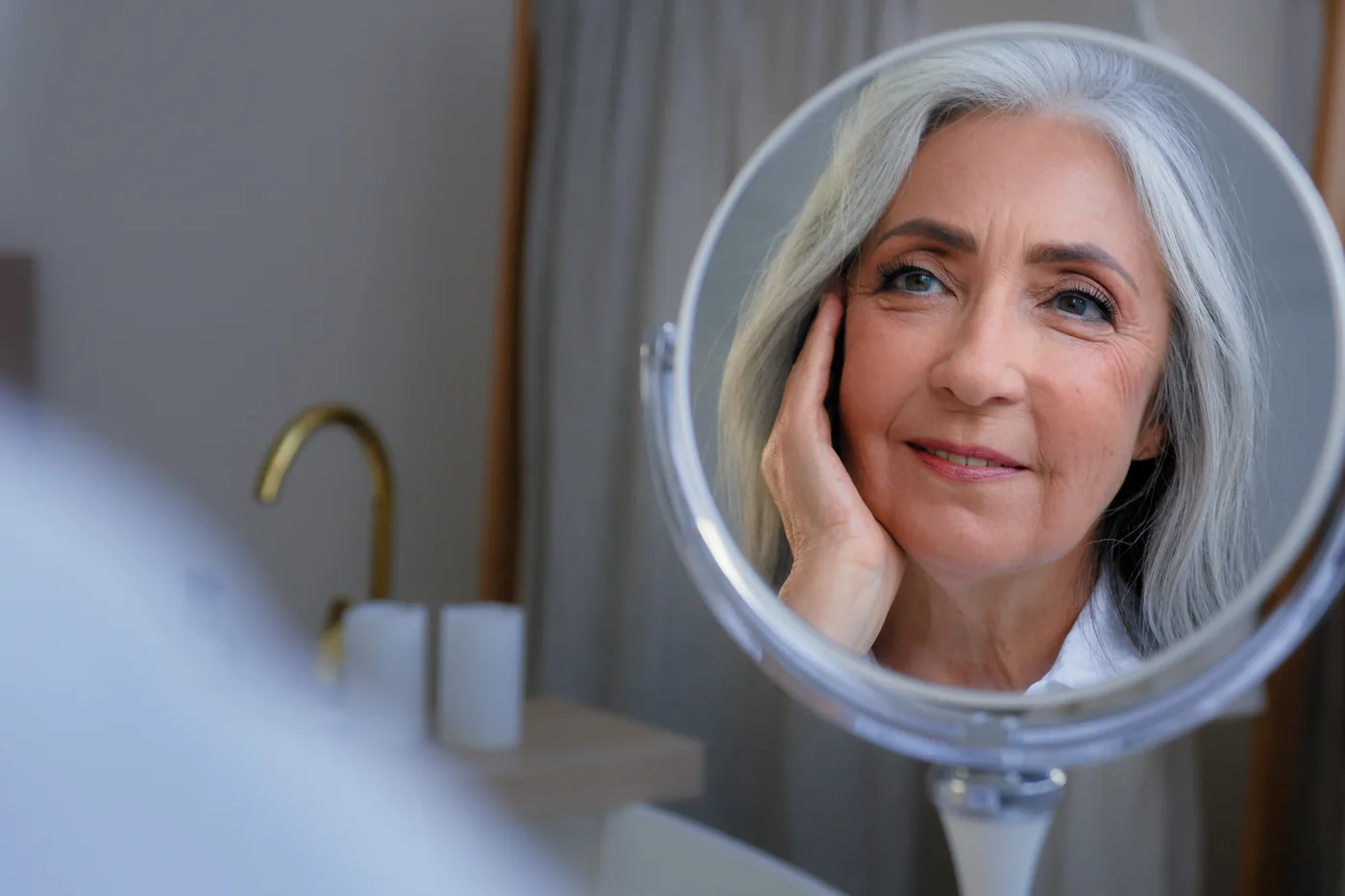
Lift the tail of your brow with a fingertip. If that millimetre opens the eye, you need a brow lift, not this. If the eye stays heavy with the brow up, the weight is in the lid.
Where the real problem is a descended brow resting on the lid, the answer is a brow and forehead lift at $5,000–7,000. Dr. Stone will show you the difference at the consultation.
03 · How it is done
In the crease above, and beneath the lash line below.
On the upper lid the incision sits in the natural crease and disappears once healed. Excess skin, muscle and fat are removed or repositioned through that one opening.
On the lower lid it goes just beneath the lash line, or inside the lid where only fat is being addressed, which leaves no external scar.
It is an outpatient operation of an hour or less, under local anaesthetic with sedation or a general where the work or the patient calls for it. The practice uses a long-acting local that can carry pain relief for forty to seventy two hours, so most patients need nothing stronger at home. A platelet rich plasma or platelet rich fibrin treatment can be added during the procedure to help the site heal.
04 · Recovery
A morning, a week of bruising, and a lid that keeps settling.
The shortest recovery on the practice's surgical list. The figures are conventional ranges. Dr. Stone will give you the numbers for your own lids.
The day
An hour or less, and home the same day
One to two hours if upper and lower lids are done together. Somebody else drives: sedation rules it out for twenty four hours.
Days two and three
Bruising peaks, then falls away
Cold compresses and sleeping propped up shorten it considerably. Tenderness, watering, light sensitivity and some blurring from the ointment are all normal.
Week one
The fine sutures come out
At around a week. Most of the healing happens inside the first fortnight and most people are back to normal activities within it.
Ten days to three months
Comfortable in company, then in photographs
Comfortable in company at ten days, in photographs at three weeks. The last swelling resolves over two to three months and the scar keeps fading past that.


05 · Compared with
Three different answers to "something about my eyes".
These are not three sizes of the same operation. One works above the eye, one on the lid, one on the surface of the skin, and it is common to need two. Each is quoted separately.
| Brow & forehead lift | BlepharoplastyYou are here | Laser resurfacing | |
|---|---|---|---|
| What it treats | A brow that has descended onto the lid, and the muscles pulling it down | Excess lid skin, and the fat that has come forward behind it | The surface only: fine crepe, pigment and texture on thin lid skin |
| Incision | In the scalp and hairline, above the problem | In the upper crease, or beneath the lash line, or inside the lid | None |
| Anaesthesia | Sedation or general | Local with sedation | Topical, or sedation if deep |
| Back to work | Around ten days | Seven to ten days | Five to ten days of social downtime |
| Results settle | Three to six months | Two to three months | Three to six months |
| Fee | $5,000–7,000 | $3,400 | From $2,000 |
Dermal filler is a fourth conversation: it can soften a hollow under the eye at $800 a syringe, but it removes no skin and repositions no fat, so it does nothing for a heavy lid.

06 · The surgeon
A lower lid gives back nothing that is taken from it in error.
Lower lids punish over-resection: take too much skin or fat and the lid pulls away from the eye, which is difficult to correct. Dr. Stone trained in oral and maxillofacial surgery across three Level 1 trauma centres, where the orbit and the tissues around it are rebuilt after injury. That is the background she brings to an elective lid.
- 01Biomedical engineering degree, then a Doctorate of Dental Surgery
- 02Full oral and maxillofacial residency across three Level 1 trauma centres
- 03Attending surgeon, Baylor and Methodist Medical Centers
- 04She plans, performs and follows up every case herself
07 · Questions
The six questions this operation raises.
Will the scars show?
In the upper crease, where it disappears once healed. On the lower lid, just beneath the lash line, or inside the lid where only fat is addressed, which leaves no external scar.
How long does it last?
The practice puts eyelid surgery at ten to fifteen years or more, and upper lid surgery is a once in a lifetime operation for most patients. You continue to age, but the tissue removed does not come back, though some choose to repeat it later for new sagging.
Will my insurance cover it?
Occasionally, for upper lids only, where excess skin is documented to obstruct the visual field. That needs formal visual field testing and photographs. It is a question for your insurer, and most cases are cosmetic.
Can filler or laser do this instead?
They address different things. Filler can soften a hollow under the eye, laser can improve the texture of thin lid skin, and for early changes either may be enough. Neither removes excess skin or repositions fat.
What happens at the consultation?
You and Dr. Stone go through your concerns and goals. She takes a medical history, assesses your general health, and takes photographs and measurements to draw the plan against your own anatomy. You leave knowing whether this is the right procedure, and if not, which one is.
What does it cost, and can I finance it?
$3,400 for upper or lower, as the practice's price list quotes it. One or both is settled at the consultation, before anything is booked. Financing runs through Sunbit, and membership credit can be applied to a surgical fee.



Book it
One surgeon, from the consultation to the last follow-up.
The consultation is $175 for Texas residents and $250 from out of state, with a $100 deposit that comes off the fee. You spend the hour with Dr. Stone, not a treatment coordinator.
- The practice
- 72 Andorra Dr #110
Westlake, TX 76262 - Hours
- Monday to Friday, 9 to 5
Saturday by appointment